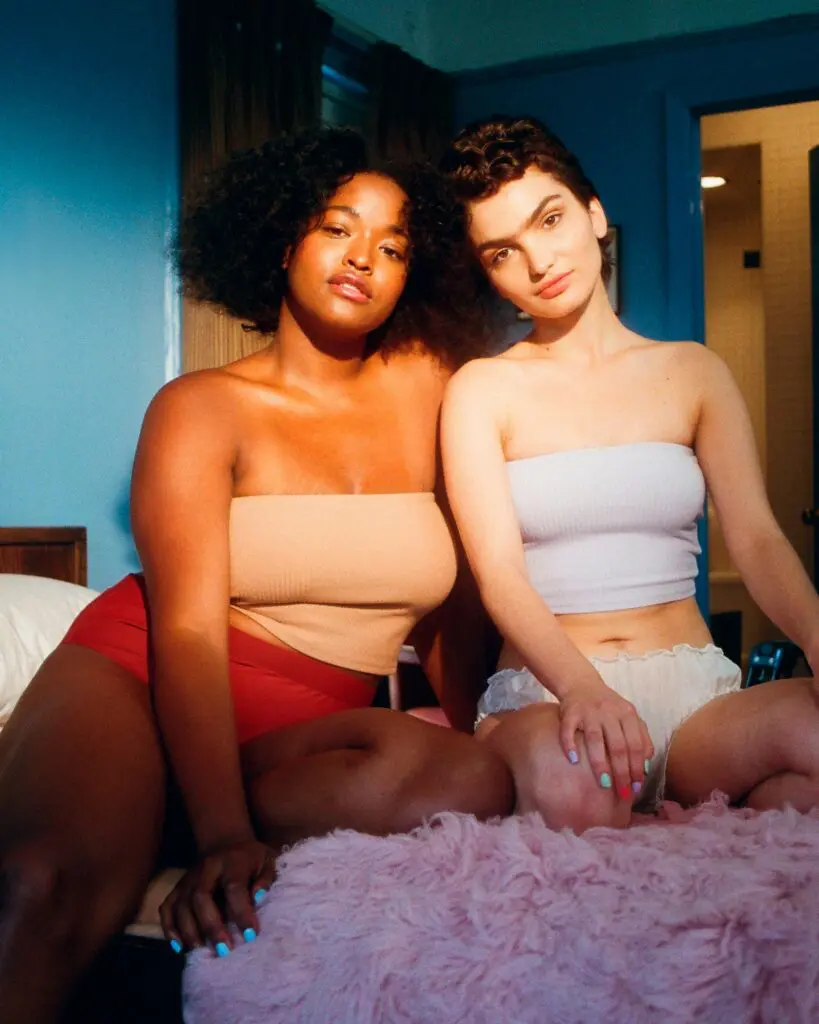
Desirability right now is softly packaged. Her lifestyle is defined by matcha after pilates, a perfectly primed blowout, and a teeny waist in the set everyone’s begging the latest hype brand to restock. She’s worshipped as the “clean girl,” dominating feeds. Her signature slicked back bun never feels clean on me, no matter how many GRWMs I watch.
Try-hard. Restricted. Messy. Out of character.
My body doesn’t fit her mold. It’s odd. Not odd as in off-putting. Anatomically uneven. I have chronic pain and bloating, and I was born without a left hand. I can’t sport the dress code like the other girls. I’m a different speed.
I’ve stopped trying to fit a norm that was never built for variation. I’m interested in styling myself to feel like me, not a consensus. Trends are like participation trophies. Who’s really in control of how we look? Chicness is observing what’s in vogue and choosing which parts are yours.
The mistake, and great disservice to the fashion industry, of aesthetics like clean-girl, cottage-core, and cherry-girl-summer, is that they don’t hold space for the eclecticism of individuality. Or the bodies that belong to the individual.
When you exist in a body that expands and contracts at the waist like a yo-yo and were born one-handed, shopping can feel heavy.
Form-fitting things irritate me. I love the silhouette of an oversized blazer like the Allegro Jacket by Come On, an amalgamation of goth meets CEO. Hard to ignore, but without comprehension. Am I bloated? Am I on my period? None of your business. That’s my style. You can still be mysterious with an incredibly expressive face and the urgent desire to overshare with every new person you meet. Even when it’s not trendy anymore.
If I wanted to feel less like I’m about to get rejected from a job interview but keep the same airy, you-won’t-see-this-body-unless-i-say-so vibe, the Jester Dress from Carmen Says, crafted with a floaty, cuddly fabric, makes getting dressed as easy as putting yesterday’s coffee in the microwave. Over the head it goes and I’m ready for the day. Add the Kurt Geiger Trekker boots—with flexible fabric and zip-ups on the inside for ease—and a vintage leather jacket, and I am who I think I am. Plus, Carmen Says fabrics are made with high-quality, sustainable viscose— I must inform the sustainability warriors immediately.
In a hormonal, fluctuating, physically demanding body, fashion is more than looks. It’s not being punished by fabric. It’s considering how the 7 p.m. version of you will feel in this outfit, not just the 8 a.m. one. Trading overthinking for uncomplicated.
I don’t have time to fasten zips. I don’t have time for twenty fiddly buttons. I don’t have time for dissociating in the mirror because my mind has latched onto its eighth existential thought of the morning—wait no, I do have time for that. I don’t have time for clothes that ask too much of me.
I’ve stood in enough changing rooms contorting my body the same way; chin bent holding the garment up, fabric scrunched, zip stuck half-way, my body firmly pressed against the wall to steady myself.
Getting dressed when you have a disability isn’t just a routine, it’s mental gymnastics: What can I wear that won’t become a problem later? What can I put on that won’t need me to think about it again? What has the fewest components? By evening, my body has made its own decisions. The indents in my skin left behind by my waistband are the words of clothing that never accounted for a body that changes over the course of a day.
Out the door. Not without my Destiny Pinto, particularly the Adison Handbag, inspired by her lived experience with rheumatoid arthritis. The Adison is designed with larger circle zips and magnetic snap closures, as well as discreet detachable back straps to secure the bag to wheelchairs, strollers, or car seats. It’s functionally badass, cherry red, and fiercely boxy. She’s the bag you’d pick if you wanted to scream: I’m here, I exist, and today, I’m taking up space. Perfect for the attention seeker in me — and you.
Melania Clara Jewelry glamorizes accessibility. Their necklaces fasten with a magnetic clasp, a one-handed woman’s secret. The Raine Necklace in ultra violet is a chunky crystal choker that announces itself. What do clean girls know about standing out on purpose? None of this should be radical. It shouldn’t require hunting. It shouldn’t require a separate industry. In mainstream fashion accessibility is not an afterthought, it’s not thought of at all.
The clean girl is rigid. She’s not an aesthetic you can mirror, or a morning routine you can start tomorrow. She’s a slim, blemish-free young woman dressed in neutrals with an oversized fixation on avocado toast. She’s a default body type that assumes—not accommodates—beauty and symmetry. She only works for someone whose body is stable and cooperative. She was never designed for chronic pain, limb difference, expanding waistlines, and acne scarring. The clean girl never skips a workout. Neither do I. Mine just doesn’t earn a highlight reel.
For years I wore long sleeves, even in summer. I stayed thin. I slathered high coverage concealer over my acne scars. I chose the thing least likely to draw attention to the parts of me outside of the brief. It wasn’t conscious. I didn’t decide “I’m going to hide today,” I just did. I was dressing around my body instead of with it; tight skirts, beige aesthetics and my midriff as an accessory. What everyone else was wearing.
The trend was never something everyone could hop on because the clean girl doesn’t account for the autonomy and distinctness of all women. She glorifies one body, and the rest of us? We orbit or float into the ether. The woman whose body changed after illness, after pregnancy, after grief, after simply getting older? The clean girl renounces her. She excludes everyone whose body has the audacity to have a history.
My body is not a problem to be solved but an individual to be styled. It took me a long time to untangle that lie. I don’t need to camouflage. I need to be unsettling and strange and still the best dressed in the room.