A woman’s body enters public view and is refracted, caught in the prism of a gaze that bends it into an appetizing object that can be consumed, interpreted, and made to signify more than ever consented to.
The appetite is paradoxical. The body becomes consumable when it doubles as spectacle — the endlessly replayed exposure of Janet Jackson at the Super Bowl halftime show, the erotic image perfected for circulation by Kim Kardashian. Controlled visibility has its own caveats. It works only when it remains legible: the kind Jennifer Lawrence delivers with disarming ease, never crossing into a register that resists interpretation. Visibility is almost always defined by the people watching.
Comedian Nikki Glaser has spent years working inside visibility; it doesn’t just accompany her, she’s structured by it. A career built in comedy comes with a particular fluency in being clipped, replayed, and reinterpreted, long after the show is over.
As a public figure, she seems attuned to the way revelation makes the public’s nerves frolic and fray at once, and she plays that collective instability like a harp. Not gently, not carefully, but precisely, as if the reaction itself is an instrument waiting to be heard.
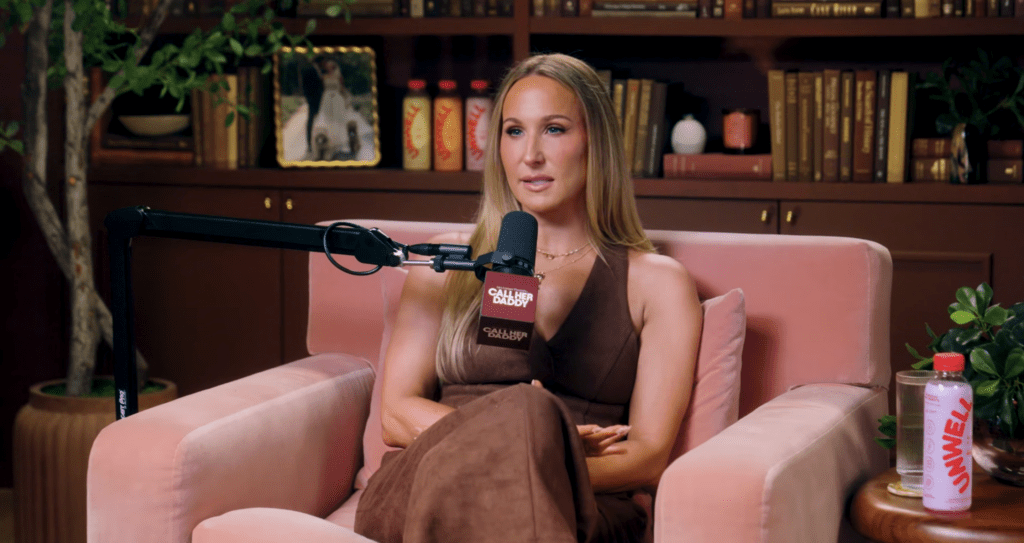
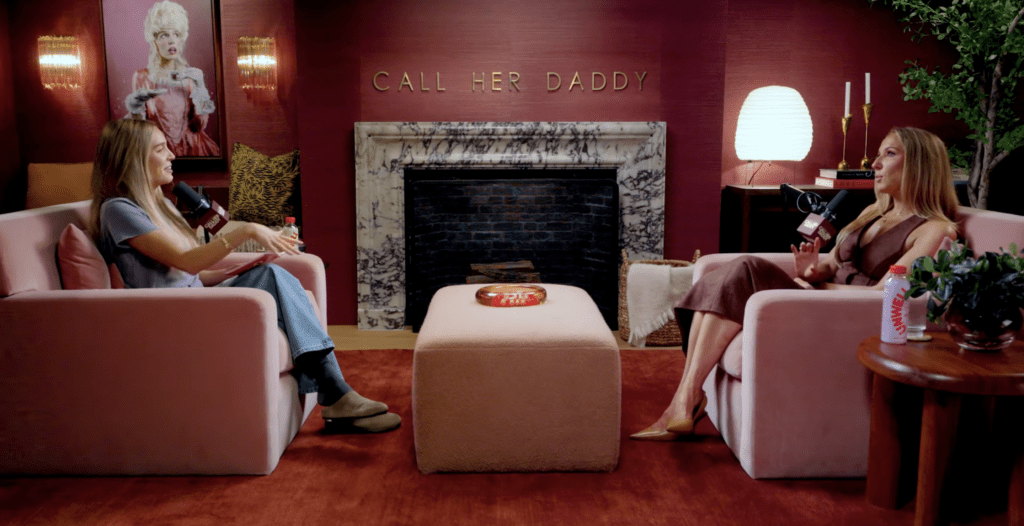
Nikki appeared on Call Her Daddy, a podcast that increasingly resembles a sort of secular confessional — part interview, part absolution ritual, part spectacle of disclosure — and admitted the idea of her boyfriend, Chris Convy, being with other women turns her on. In her telling, his sexual history, or anything that exists beyond her, doesn’t register as jealousy or rupture but as a quality that intensifies desire.
The conversation sits in that uneasy space where nothing is outright unsettling, but nothing fully settles either — the way a familiar song feels when it’s played in a different key. “In a relationship, I don’t really care if my boyfriend were to hook up,” she told host Alex Cooper. “But that is not a two-way street. I’m not someone who likes to hook up when I’m in a relationship. I don’t really care about that. But I don’t care if someone else were to. In fact, I kind of like it.”
It was here that Nikki returned to the pulpit of her own desire and testified to the quiet part out loud, not as a joke, not as a shield. She spoke of wanting without possession, of arousal unfastened from the old covenant of emotional exclusivity. She offered the image plainly: that a partner’s intimacy with others excites her. Provocative. The acceptable response is diminishment.
What lands first is how matter-of-fact it is, almost disarmingly so. She doesn’t circle the edges or cushion in explanation. Her words arrive fully assembled, a thought she’s already been living inside long enough that it no longer needs placating. It has the flat clarity of a decision in practice.
Her affect feels off. It strips away what people usually expect to be there. The hesitation, the balancing act, the reflex to contort desire into something symmetrical or morally even. None of that surfaces. Instead, there’s tension she holds without visible strain. It’s there, just not in her, as if exclusivity simply isn’t the axis she organizes around.
There was no repentance in it, no reaching for forgiveness. A slight charge in its place, the shock of a forbidden thought that has been named too directly. Then the tone changes. It tilts toward pleasure. “It would really be like foreplay for me. I would get revved up talking about it,” she shared on the podcast, describing what became a specific turn-on for her. As time went on in her relationship, Nikki said she eventually grew bored with Chris’ old stories and encouraged him to “get some more.”
It’s almost gluttonous. She wants to collect his stories, curate and stack them in this private, ever-growing archive. His past not a threat but an addition. A scrapbook of other women Nikki welcomes in lieu of seeking to destroy.
Archives get repetitive. Curated desire starts to feel familiar once you’ve run your fingers across the same material too many times. The stories lose their bite. So she’s open to something fresh. “If a guy has a sexual connection with a woman and uses protection, just having sex for a night, I literally wouldn’t care if my husband did that,” Nikki said. Though her openness has limits, “I don’t know why. But if he were to watch The Wire with her, do crossword puzzles, or send memes and stuff, I’d be like, ‘What the fuck are you doing? That’s our thing.’”
Jealousy is not absent, it’s just been rerouted. The usual center of gravity, sex, doesn’t hold power in her framing. Nikki shifts the weight somewhere else entirely. Into the small, almost invisible architecture of a relationship. Watching the same shows, sending memes, the constant drip of “this is ours” without ever having to name it.
That’s where her commitment instincts kick in. They’re not missing, but they exist outside the obvious markers people tend to focus on. The quiet circuitry that supports connection is her territory and hers only. And in that sense, jealousy stops being about the physical and starts looking like a reaction to replacement at the level of daily rhythm. Her territory is the mind. The body is negotiable.
It’s an uncanny inversion. Sex she can handle. Sex is just sex. But someone slipping into the shared pulse of their life — taking up space in the background noise that usually belongs to just two people syncing without thinking, that’s off limits.
Once spoken, it refused to stay contained. Lifted out of that dim, velvet space of podcast intimacy and carried into the open, Nikki’s choices took on a different weight. The candor felt, to some, like a breach. It seemed to desecrate, or at least question, the shared doctrine of how desire is supposed to behave.
Her remarks were repeated with a near-liturgical sense of scandal, like the boundaries of propriety had been violated. Public reaction read as a form of moral recoil — her articulation of desire treated as an affront to the compliance and silence expected of women. TikTok, where commentary culture and virality converge intensely, amplified the scrutiny. Nikki’s remarks were often collapsed into a simplified reading of her persona, as though the ambiguity of her statement could be resolved through immediate judgment.
The reaction doesn’t stay with what she said for long. On a post from Page Six, the comment section drifted quickly into reading her instead of the conversation. The original point gets flattened into psychoanalysis, with unqualified strangers online arguing about what her openness signals about her as a person.
“Girl, you have some healing to do.” “I’m just a cool, chill girl.” “I’m really disturbed by this, I hope she’s okay,” turns into this loop about whether she’s normal or readable in the right way — if she’s serious or rage-baiting or being paid to be funny like always.
Why are we reluctant to accept that a woman can inhabit the so-called “cuck chair?” That she can, in a sense, relinquish herself to the imagined or real sexual autonomy of her partner, and even siphon meaning, arousal, or identification from it? It’s a legitimate kink.
We’re in a state of constant pathologizing, an uncustomary thought or lifestyle is diagnosed as unwellness by conformists, not recognized as non-conformity. Society doesn’t metabolize disruption. It dilutes it.
Meanwhile, we are already conditioned toward a kind of anxious authorship over intimacy — expressing franticness at the mere mention of an ex’s past. Women are often positioned as guardians of retroactive jealousy, sitting on the throne of what has already happened, trying to regulate it after the fact. Triggered by another woman’s existence.
Someone lands differently — off-key, electric — and for a brief second we lean in. But only because we’re listening for the moment we can crucify. We reach for it almost immediately, that alienation.
You can see the reflex kick in. On Fox, with Jackie Dorman — a relationship expert, which somehow makes the scolding feel justified — the comment doesn’t get to remain a comment. It gets escorted, ushered out of its own strangeness and back into familiar rooms. She’s a comedian, so maybe it’s a performance. She moves in male spaces, so maybe it’s an adaptation. The possibilities stack up like polite excuses, each one sanding down the edges a little more than the last.
Preposterous. It registers as surprising, even unintelligible, when a woman describes sexual pleasure without staking it on exclusivity or possession. When she wants what might be called relational permeability, allowing desire to be unconfined, shaped by her partner’s life beyond her. The belief that she can want this, apparently, needs explaining.
She’s a woman with a platform, which places the burden of agreeability on her. Deviating from the norm, especially with a mic, gets you picked apart until you adhere. Ask Nikki, who revealed on Kara Swisher’s podcast that she’s embarrassed about the fallout and humiliation she experienced after the Call Her Daddy episode aired and wasn’t thinking to censor herself. She shouldn’t have to, but look what happens when a woman doesn’t.
Image: Call Her Daddy/Youtube.