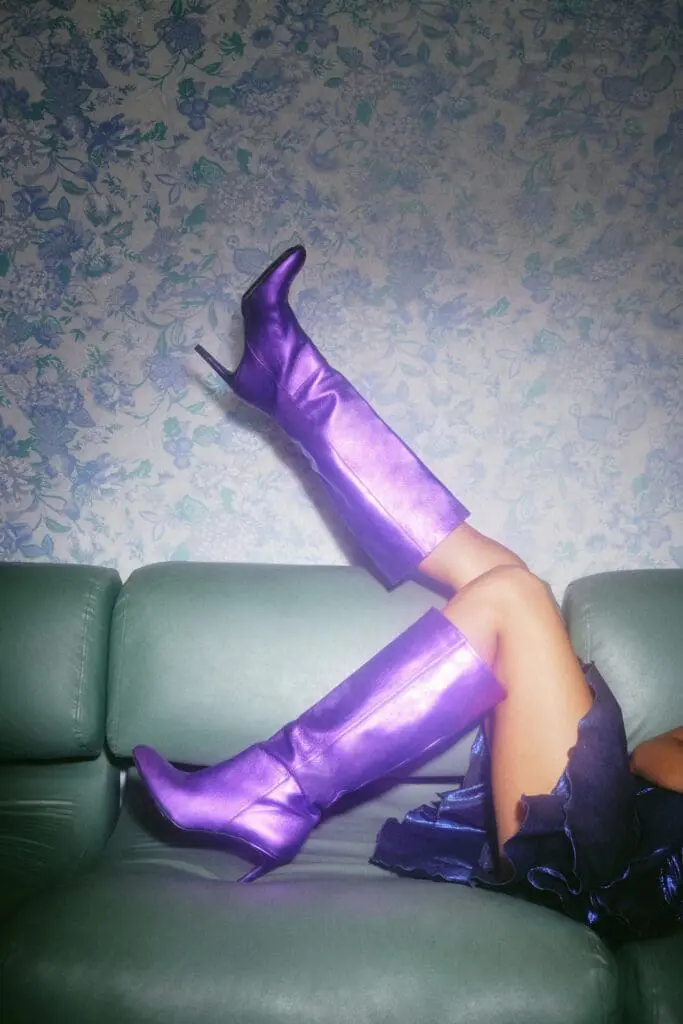
“Did you see what she was wearing?” is one of the first social currencies girls inherit. Before desire has language, it has silhouette. We wobble through childhood in our mothers’ oversized shoes, rehearsing womanhood long before our feet can carry its weight, trusting we will eventually grow into the outline.
Youth convinced me my body was a temporary spectacle requiring precise architecture — waist cinched, hips honored, collarbone illuminated like small ceremonial altars before time softened them into adulthood. With the devotion of someone preparing for a life perpetually in inception, I purchased clothes for futures that existed predominantly in imagination.
My closet is an archive of potential, dense with speculative selves and the lives they might have occupied. Each hanger carries an unfinished arc. One of me dresses for spontaneous nights dissolving into sunrise, flirtations in bathroom mirrors sticky with spilled liquor and perfume, dinners elongated by candlelight and deliberate eye contact.
I shopped for unanswered invitations, manifesting a reality where plans effortlessly materialized and beauty summoned opportunity. Instead, the garments remained suspended in wait, sequins catching a hint of light in the disappointment of dormant ambitions.
My alter ego wears dresses sliced low across the chest. I wait for a body braver than mine to arrive and animate them. One is cut too low to feel accidental — a black slip dress with an exposed back, suggests a desire for attention that lingers longer than etiquette permits. Reconciling that she is me makes it harder to put on.
She reaches for a kind of merciless optimism, a slouchy off-the-shoulder cinched waist mini revealing a cheek in club lighting, an outfit that may burn off in daylight. The alter ego belongs to nights that begin late and refuse to end cleanly — Uber rides with smudged lipstick, laughter echoing in stairwells, the metallic taste of confidence that feels slightly borrowed. The iteration of myself who does not hesitate before being seen.
Skirts carry the most ambition. They understand exposure as a kind of thesis not a risk. Shorter than necessary, cut with a false clarity that assumed I would move through the world unbothered by attention. A black pleated mini still hangs with its tag intact, a reminder of an inhabitation that never happened.
I imagine them in motion, crossing streets with power, stepping out of cars flaunting high hems, sitting in crowded spaces undeterred by minimal coverage. There was a particular fantasy of recklessness stitched into them, the idea that confidence could be worn, that enough bare thigh might translate into certainty.
Some were bedazzled, others barely structured at all, exposing facets of myself who wanted my reality to be less cautioned: the girl who lingers at parties, who stands under club lights without thinking to disappear, who treats being looked at as something neutral rather than consequential.
Youth hinges on a willingness to overestimate its own future. A delusional grandeur: the belief that the ordinary might suddenly arrange into significance if one arrives dressed accordingly.
The girl who wore low-rise jeans without tugging at the waistband, the girl who carried sequined handbags with nowhere practical to put her keys, the girl who treated visibility like a form of self-possession.
Mini bags were never meant to carry anything so mundane as utility, only fragments of glamour: a compact mirror, lip gloss for reapplication, cash folded small enough to disappear. I wanted to signal that my life contained exits and re-entries, that I moved through spaces instead of merely occupying them.
There was ambition in every accessory. A kind of feverish aspiration. I collected leather, rhinestones, pink satin, and oversized sunglasses tinted the color of weak rosé.
The outfits could have belonged to a paparazzi photograph or a blurred celebrity in a magazine spread. I conflated a visible identity with evidence of existence. I imagined wearing the oversized shades on hungover mornings in other people’s apartments, coffee in hand, hair still undone, hiding my eyes from a wild night that I can’t remember. A shield, yes, but also a declaration that I belonged to a world where being recognized was unavoidable.
Adorning myself — chain belts heavy with unnecessary hardware, train conductor hats added to my cart with the confidence of someone who believed eccentricity alone could manufacture intrigue — my accessories gather dust in drawers and on closet shelves, relics of failed self-inventions. Embellishment cannot interrupt the monotony of ordinary existence. Enough styling will not elevate an afternoon into something worthy of an audience.
As if a chain belt slung low enough across the hips could immortalize a convenience store run into a paparazzi ambush, or a patent leather cap tilted just slightly off-center could suggest a nightlife scandal dramatic enough to require recuperation the next morning.
Youth hinges on a willingness to overestimate its own future. A delusional grandeur: the belief that the ordinary might suddenly arrange into significance if one arrives dressed accordingly. Eventually, accessories begin compensating for the evaporation of that story. None of it looked excessive then because the future itself still felt excessive.
My feet, too, were grounded in the same mythology. I deemed it bravado in patent Betsy Johnson shoes, chunky heels, and fluffy Ugg boots. For stomping into entrances I had never been invited to make, the sound alone announcing an arrival of another self.
The wardrobe expanded around fantasies of becoming more — louder, desired, conspicuous, shameless in my femininity. I wanted to wear revealing clothes not accidentally or apologetically, but triumphantly, with the lacquered confidence of women photographed stumbling out of clubs in the early 2000s, all bronzed limbs and brazen sultriness.
Victoria’s Secret lingerie folded carefully inside my dresser drawers, an all black lace, pink satin, and tiny ornamental bows. I acquired them with the reverence of investment pieces, existing slightly outside my financial reality. I fantasized about intimacy and feeling coveted: slipping beneath white hotel sheets, moving through candlelit bedrooms with the effortless seduction lingerie advertisements seemed to promise. Instead, the bras remained fastened on their hangers, the lace untouched except by my own hands.
Between adolescence and adulthood, experimentation stopped feeling instinctive and began feeling overly visible. I owned the clothes, certainly — rows of them in impossible colors and abbreviated cuts — but not always the sudden courage required to dress them on my body.
I picked up long-sleeve mesh tops, ribbed shrugs, bolero cardigans, and sheer layering pieces: the basics. They were bought for the idea of fashion as cumulative and expressive, but became instead fragments of that intention, isolated gestures, never a composed look. The fantasy was multiplicity; the reality was reduction. The boleros stayed unbuttoned and irrelevant, the mesh tops treated as singular statements not connective tissue.
They belonged to an image of me that felt brighter, bolder, accidentally cinematic — mornings that began with iced coffee and lip gloss instead of exhaustion, errands conducted with the self-awareness of a montage in place of routine.
The closet lost its sense of exploration. It exists as evidence of all the what-ifs, of all the ways I could’ve been audacious on any given evening. The garments remain where I left them: structured, embellished, unapologetic in their readiness, and waiting for me to join.
I haven’t abandoned myself. I try them on sometimes in the quiet of a room that is not preparing for anything. The mirror does not flatter or forgive, only reflects the distance between intention and arrival. A dress becomes just a dress again.
Nothing about them feels entirely unused — they’re figments of possibility. For now, they hang like unfinished sentences. Still charged. Still waiting. Still, in their own way, already worn.