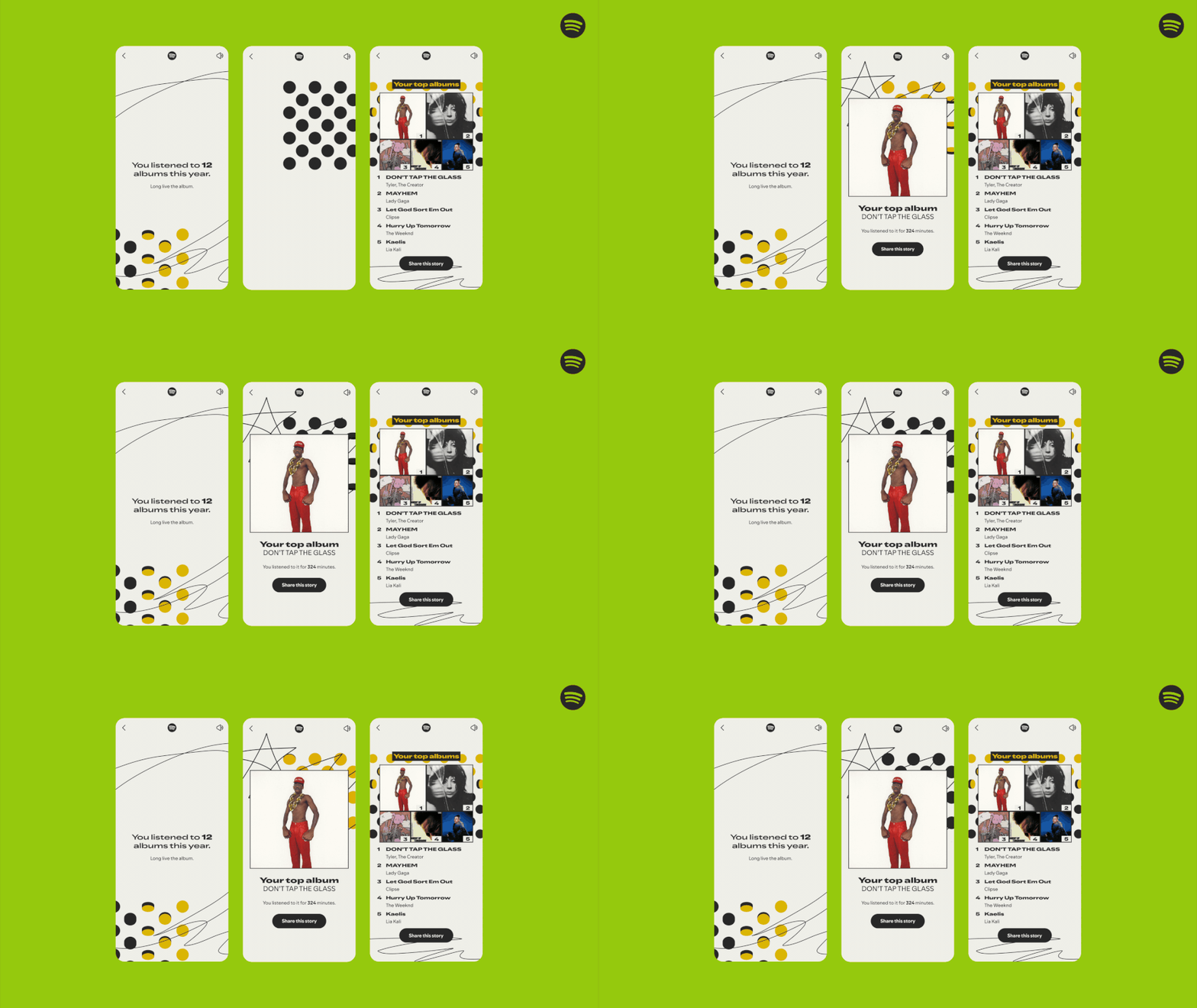
Every year, Spotify tells me who I have been. Not in a literal sense — no algorithm can account for the unrecorded parts of life — but in a way that feels uncomfortably close. It tracks patterns I wasn’t fully attuned to, though I hovered at the edge of recognition. My listening habits are no longer passive, but declarative — artists whispering back what I had not said out loud.
Moods I thought were fleeting and tendencies I would rather call “taste” than “habits.” My Spotify Wrapped has been summarizing emotions I haven’t fully articulated, things I would not admit, too heavy for the bluntness of conversation, only made tolerable with a soundtrack behind them.
Music gave me a lineage of emotional bandwidth in the tumultuous sprawl of adolescence. Songs felt psychic — a language beyond language — speaking directly to the fever and foresight of being alive inside an existence that already felt insurmountable. Entire philosophies were distilled into rhythm and rhyme. And my mind, still impressionable with youth, expanded itself through sound, carrying those frequencies forward into adulthood.
“Long Way 2 Go” arrived in my childhood as a low, indecipherable buzz. I imagined adulthood as a state of effortless social orbit: clubbing without self-consciousness and desire without fixation. Nowhere near the age of its target demographic at release, I attached myself to the feeling it embodied. At 25, I’m less interested in the sound than in what I wanted from it: detachment, an effortless nonchalance that felt coordinated more than defensive.
As someone who relapses easily on the potential idea of a person, “Long Way 2 Go” offered a temporary inhabitation. A version of myself that could want without spiralling, desire without constructing an entire future around it. Where music has the capacity to become an ordained sense of certainty, I treated Cassie’s proclamations as commandments. There was something enviable about the fluency with which she seemed to navigate the beginnings of desire, as though she had already seen every permutation of someone’s intentions and could respond decisively. I listened to “Long Way 2 Go” for restraint.
Everyone had a Tumblr when this came out, and I desperately wanted to be part of the masses of fishnets, Doc Martens, and perfectly faded turquoise hair. The hypotheticals coincided neatly with my own — teenage me existed in a near-constant state of hypotheticals. While friends were fumbling their way through middle-school relationships, I was more invested in the idea of romance than its reality. With Alex Turner’s sultry voice and well-earned reputation as a yearner, “Do I Wanna Know?” became a sanctuary.
Long after adolescence has surrendered its excuses, I remain embarrassingly willing to mistake potential for intimacy. Turner’s devotion once registered as a cautionary tale — a warning about the ways yearning can outlive its usefulness — but warnings sound like aspirations in my ears. The song became another place to indulge my preference for the imagined over the actual, to linger in uncertainty in fear of the answer.
If avoidant attachment has taught me anything, it’s how to relish the hypothetical. I can construct emotional empires from a glance, a text, a possibility, only to retreat when something asks to become real. I play it on repeat — an admission of a habit I hadn’t yet learned to name: leaving early before desire could turn into need.
Brought on by a familiar pattern of pursuit, “Circles” is an outlier in the lineage of angsty teenage music, pulling me into a slightly detached, investigative state where I am already half-out of whatever emotion I’m moving toward. It feels slightly masochistic, admittedly, to dwell on. The song is steeped in the aftermath of adult misfires: a man narrating to his presumed partner the weight of her past relationships, insisting he cannot be held responsible for the indiscretions of others, while also refusing to be collapsed into them. It’s a kind of house of mirrors for me.
Since the narrator is addressing a woman, I instinctively assume the hypothetical position but find myself rendered into an unfamiliar role — the recipient of my longing. Avoidance masquerading as discernment, distance mistaken for self-preservation, and discomfort with uncertainty return to me from the opposite direction. Usually, the songs on my playlist have allowed me to pass off my impulses as methodological; this one confronts me with the honesty that they were experienced by other people. That my departures, however reasoned they felt from the inside, may have registered as confusion, absence, or abandonment from the opposite end.
I heard how I compile men into a one-dimensional rationale of disappointment or inevitability, without accounting for my own failures within those dynamics. I find comfort in flattening them into something legible because it removes the need to sit with my own inconsistencies, my own exits, my own inability to fully stay present when romance is on the table. “Circles” forces a different vantage point — I have reduced men into categories, and there is a version of me that requires that reduction to function.
The person Spotify knows reaffirms herself with the persistence of unfinished thoughts, preserving emotional habits long after they have ceased to feel conscious. My Wrapped archives my avoidance. Not who I was listening to, but who I kept becoming when I listened.
Image courtesy of Spotify.